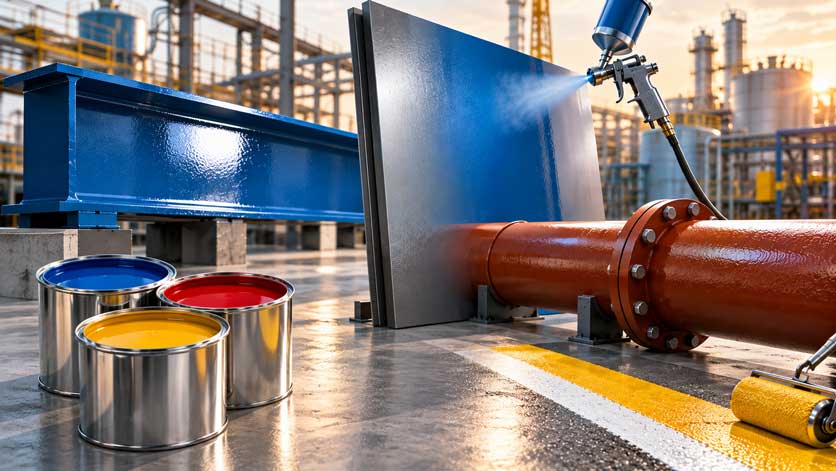
Industrial paints play a critical role in protecting equipment, machinery, metal structures, and infrastructure from harsh environmental conditions. Unlike conventional decorative paints, industrial coatings are engineered to provide specialized protection against corrosion, chemical exposure, abrasion, moisture, and temperature variations.
Choosing the right industrial paint is essential for maintaining the performance, appearance, and longevity of industrial assets. Whether you operate a manufacturing facility, manage construction projects, or work in the automotive, marine, or oil and gas industries, understanding the
different types of industrial paints can help you make more informed decisions.
Industrial coating systems differ significantly in their chemical composition, protective properties, durability, and recommended applications. Some formulations are designed primarily for corrosion resistance, while others prioritize chemical resistance, mechanical durability, weather protection, or aesthetic performance.
In this comprehensive guide, we explore the main types of industrial paints, their advantages and limitations, common applications, and the essential factors to consider when selecting the most suitable coating system for your project.
What Are Industrial Paints?
Industrial paints are specialized protective and decorative coatings formulated to meet the demanding requirements of industrial environments.
These coatings create a protective layer between the underlying material, known as the substrate, and potentially damaging external conditions.
Industrial paints are commonly applied to steel, aluminum, concrete, machinery, equipment, and other surfaces where long-term protection is required.
Depending on their formulation, industrial paints may provide several important functions:
- Corrosion protection: Helping prevent rust and deterioration caused by moisture, oxygen, and corrosive environments.
- Chemical resistance: Protecting compatible surfaces against exposure to specific chemicals and industrial contaminants.
- Abrasion resistance: Reducing surface damage caused by mechanical wear and frequent contact.
- Weather resistance: Protecting surfaces exposed to sunlight, rain, humidity, and changing temperatures.
- Improved appearance: Providing consistent colors, gloss levels, and decorative finishes.
- Specialized performance: Offering properties such as heat resistance, electrical insulation, or improved cleanability when specifically formulated and tested for those purposes.
The effectiveness of an industrial coating depends not only on its chemical composition but also on substrate compatibility, environmental conditions, surface preparation, and the overall coating system.
8 Main Types of Industrial Paints and Their Applications
Industrial coatings can be classified according to their resin chemistry, protective mechanism, or application technology. The following are eight important categories used across different industries.
1. Epoxy Paints
Epoxy industrial paints are among the most widely used protective coatings for industrial environments because of their strong adhesion, durability, and resistance to many chemicals.
Most high-performance epoxy coatings are two-component systems that form a cross-linked protective film after curing.
Key benefits of epoxy paints:
- Excellent adhesion to properly prepared surfaces
- Strong resistance to abrasion and mechanical wear
- Effective corrosion protection in suitable systems
- Good resistance to selected chemicals and industrial contaminants
- Availability in high-build protective formulations
Common applications:
Epoxy coatings are frequently used for industrial flooring, steel structures, machinery, storage tanks, pipelines, and marine equipment.
They are particularly valuable where surfaces experience mechanical stress, moisture, or chemical exposure.
Important consideration: Conventional epoxy coatings can lose gloss and develop surface chalking under prolonged ultraviolet exposure. For outdoor applications where appearance matters, a compatible UV-resistant topcoat is often recommended.
2. Polyurethane Paints
Polyurethane industrial coatings are widely recognized for their durability, attractive finish, and resistance to weathering.
Aliphatic polyurethane formulations are especially suitable for exposed exterior surfaces because they offer excellent color and gloss retention.
Key benefits of polyurethane paints:
- Excellent weathering resistance in suitable formulations
- Good color and gloss retention
- Durable, attractive surface finishes
- Resistance to abrasion and selected chemicals
- Availability in different colors and gloss levels
Common applications:
Polyurethane coatings are commonly specified for industrial equipment, structural steel, transportation equipment, exterior machinery, and industrial buildings.
They are frequently used as finishing coats over compatible epoxy primers or intermediate coatings.
Important consideration: Polyurethane performance varies according to its chemistry. Not every polyurethane coating provides the same UV, chemical, or mechanical resistance.
3. Alkyd Paints
Alkyd paints are traditional industrial coatings known for their relatively straightforward application, decorative appearance, and economical performance.
These coatings use alkyd resins as their main film-forming material and are commonly selected for general-purpose metal protection in mild environments.
Key benefits of alkyd paints:
- Cost-effective protection for suitable applications
- Good decorative appearance
- Availability in a variety of colors and finishes
- Suitable performance for light industrial maintenance
- Practical use on machinery and metal components
Common applications:
Alkyd paints are often used on agricultural machinery, equipment enclosures, metal furniture, structural components, and general industrial surfaces.
Important consideration: Alkyd coatings generally provide less resistance to severe chemical exposure and aggressive corrosive conditions than properly specified high-performance epoxy systems.
They may also require longer drying periods than some alternative technologies.
4. Acrylic Industrial Paints
Acrylic industrial coatings are valued for their appearance, color retention, and versatility.
They are available in water-based and solvent-based formulations, with performance varying significantly between products.
Water-based acrylic coatings are particularly useful in certain commercial and light industrial environments where reduced solvent emissions and easier maintenance are priorities.
Key benefits of acrylic paints:
- Good color retention in suitable exterior formulations
- Availability of water-based options
- Relatively fast drying in many formulations
- Attractive decorative finishes
- Good resistance to weathering in appropriately designed systems
Common applications:
Acrylic coatings are used for industrial buildings, equipment surfaces, metal structures, and maintenance projects.
They can also serve as protective finishing layers when combined with compatible primers.
Important consideration: Acrylic coatings should be selected according to the required corrosion resistance, chemical exposure, and substrate type. A general-purpose acrylic paint is not automatically suitable for highly corrosive industrial conditions.
5. Zinc-Rich Protective Coatings
Zinc-rich coatings are specialized anti-corrosion materials primarily used as primers on appropriately prepared steel surfaces.
Unlike coatings that rely mainly on a physical barrier, zinc-rich primers can provide additional sacrificial corrosion protection when the formulation and application conditions support the required electrical contact.
Key benefits of zinc-rich coatings:
- Strong corrosion protection in suitable steel coating systems
- Additional sacrificial protection for compatible applications
- Useful performance in demanding atmospheric environments
- Compatibility with selected industrial intermediate coats and topcoats
Common applications:
Zinc-rich primers are widely used in protective systems for bridges, structural steel, industrial plants, port facilities, and certain marine infrastructure.
A typical high-performance protective system may incorporate a zinc-rich primer, epoxy intermediate coating, and polyurethane topcoat.
Important consideration: Zinc-rich coatings are not interchangeable with ordinary finish paints. Their protective performance depends heavily on surface preparation, formulation, system compatibility, and service conditions.
6. Silicone-Based Heat-Resistant Paints
Some industrial equipment operates at temperatures beyond the capabilities of conventional coating systems.
Specialized
heat-resistant industrial paints, including certain silicone-based formulations, are developed for these environments.
Key benefits of heat-resistant coatings:
- Resistance to elevated operating temperatures within specified limits
- Protection of suitable industrial equipment
- Improved coating stability under defined thermal conditions
- Availability in formulations designed for repeated heating and cooling cycles
Common applications:
Heat-resistant coatings may be specified for industrial exhaust systems, furnace exteriors, heat-processing equipment, and selected components of industrial plants.
Important consideration: The maximum continuous operating temperature, peak temperature resistance, substrate compatibility, and exposure conditions must be verified using the manufacturer's technical data.
7. Powder Coatings
Powder coating is a different type of industrial finishing technology that uses dry coating particles rather than conventional liquid paint.
It is widely used in controlled manufacturing environments to produce protective and decorative finishes.
Key benefits of powder coatings:
- Durable finishes with good mechanical resistance
- Attractive colors and surface textures
- Efficient use of coating materials in suitable production systems
- Availability of formulations with good outdoor durability
- Reduced reliance on liquid solvents during coating application
Common applications:
Powder coatings are commonly used on metal furniture, appliance components, electrical cabinets, automotive parts, and manufactured metal products.
Important consideration: Powder coating typically requires specialized factory equipment and controlled curing conditions, making it less practical for many on-site maintenance projects.
8. Polysiloxane Coatings
Polysiloxane coatings are high-performance protective finishes designed for demanding industrial environments.
Certain formulations combine strong weathering performance with long-term appearance retention, making them suitable alternatives to traditional multi-layer protective systems.
Key benefits of polysiloxane coatings:
- Excellent exterior durability in suitable formulations
- Strong color and gloss retention
- Resistance to weather-related deterioration
- Potential reduction in the number of coating layers in selected systems
Common applications:
Polysiloxane coatings are used in demanding protective applications involving infrastructure, industrial structures, and exposed steel surfaces.
Important consideration: These coatings can involve higher initial material costs, and their suitability should be assessed against the complete project specification.
Comparison of Different Types of Industrial Paints
The following table summarizes the general characteristics of common industrial coating technologies.
| Industrial Paint Type |
Main Advantage |
Typical Application |
Main Consideration |
| Epoxy |
Adhesion and chemical resistance |
Floors, tanks, steel structures |
Limited UV appearance retention |
| Polyurethane |
Weathering and color retention |
Exterior equipment and steel |
Formulation-dependent performance |
| Alkyd |
Economical general protection |
Machinery and light industrial steel |
Limited severe-environment resistance |
| Acrylic |
Appearance and versatility |
Buildings and equipment |
Requires application-specific selection |
| Zinc-rich |
Sacrificial corrosion protection |
Structural steel and bridges |
Requires compatible system design |
| Silicone-based |
Heat resistance |
High-temperature equipment |
Strict temperature suitability |
| Powder coating |
Durable factory-applied finish |
Manufactured metal products |
Specialized production requirements |
| Polysiloxane |
Long-term weathering performance |
Exterior infrastructure |
Higher initial material cost |
Note: Actual performance depends on the specific product formulation, surface preparation, film thickness, and operating environment.
How to Choose the Right Industrial Paint
Selecting the best industrial paint requires evaluating several technical and economic factors.
Rather than focusing exclusively on paint chemistry or purchase price, the goal should be to identify a coating system that delivers reliable protection throughout the expected service period.
1. Identify the Surface Material
The first consideration is the substrate.
Industrial coatings may be required for carbon steel, galvanized steel, aluminum, concrete, or other engineered materials.
Different substrates have different adhesion and protection requirements.
For example, a coating designed for carbon steel may not provide the same performance on galvanized metal without an appropriate compatible system.
2. Evaluate Environmental Exposure
Environmental conditions directly affect coating durability.
Important factors include humidity, atmospheric contaminants, salt exposure, temperature changes, and ultraviolet radiation.
For steel structures,
ISO 12944-2 defines atmospheric corrosivity categories ranging from C1, representing very low corrosivity, to CX, representing extreme corrosivity.
Understanding the exposure category helps guide the selection of an appropriate protective coating system.
Projects involving severe marine or industrial exposure generally require more demanding protective specifications than equipment installed in controlled indoor environments.
3. Consider Chemical and Mechanical Resistance
Industrial surfaces may experience contact with processing chemicals, cleaning agents, moisture, or abrasive materials.
The required protection should be established according to the actual operating conditions.
Epoxy coatings are frequently considered for industrial floors and chemically demanding environments, while other coating chemistries may be preferred for exposure to particular substances or operating temperatures.
Chemical resistance must always be verified against the specific product's documented performance rather than assumed from the coating family alone.
4. Determine the Required Appearance
Industrial coatings provide both protection and visual identity.
Equipment manufacturers and facility operators may require consistent colors, specific gloss levels, or finishes that maintain their appearance under outdoor exposure.
For projects where long-term color and gloss retention are important, suitable polyurethane, acrylic, or polysiloxane coatings may be considered.
Appearance requirements should be balanced with the protective performance expected from the complete coating system.
5. Review Surface Preparation and Compatibility
Even a high-quality industrial paint can perform poorly when the substrate or underlying coating system is unsuitable.
Surface condition, contamination, existing coatings, and primer compatibility all influence long-term adhesion and durability.
For maintenance projects, it is particularly important to establish whether a new coating is compatible with existing paint layers.
Surface preparation and coating specifications should follow the manufacturer's technical documentation and relevant project standards.
6. Consider Application Conditions and Maintenance
Industrial coating selection should account for the conditions under which professional coating work will take place.
Some systems have specific requirements related to temperature, humidity, curing, or application equipment.
A coating that performs exceptionally well in a controlled factory may not be suitable for a maintenance project in an exposed outdoor location.
Future inspection and maintenance requirements should also influence the selection process.
7. Compare Long-Term Cost Instead of Initial Price
The least expensive industrial paint is not necessarily the most economical option over the service life of an asset.
A complete cost comparison should consider:
- Initial coating material costs
- Surface preparation and application expenses
- Expected maintenance requirements
- Potential production downtime
- Inspection and repair costs
- Anticipated coating service life
Higher-performance coatings may provide better long-term value when they reduce maintenance frequency or help prevent premature deterioration.
However, the most sophisticated coating is not always necessary. The appropriate specification depends on actual operating conditions and performance requirements.
Understanding Industrial Paint Systems: Primer, Intermediate Coat, and Topcoat
Industrial surface protection often involves more than a single coating.
A properly designed system may consist of multiple layers, each serving a different purpose.
Primer: The Foundation of Protection
A primer promotes adhesion between the substrate and the protective coating system.
Depending on the formulation, it may also contribute to corrosion resistance.
Epoxy primers and zinc-rich primers are examples used in different industrial applications.
Intermediate Coat: Additional Barrier Protection
Intermediate coatings help establish the required protective film thickness and improve resistance to environmental exposure.
High-build epoxy coatings are frequently specified for this purpose in protective steel coating systems.
Topcoat: Final Protection and Appearance
The topcoat forms the exposed outer layer of the system.
It may be selected for weather resistance, color retention, cleanability, or additional surface durability.
For example, a suitable aliphatic polyurethane topcoat can help maintain appearance in outdoor environments.
The main advantage of a multi-layer coating system is that individual layers can provide complementary protective properties.
However, not every industrial project requires three separate layers. The correct system depends on the coating specification, substrate, exposure conditions, and required performance.
Industrial Paint Standards and Quality Control
Industrial paint performance should be evaluated using appropriate technical standards and verified product data.
Several internationally recognized standards support coating specification and quality assessment.
ISO 12944: This series addresses corrosion protection of steel structures using protective paint systems. ISO 12944-2 classifies environments, while ISO 12944-5 provides guidance on protective paint systems for specified conditions.
ASTM D7091: This standard describes practices for measuring dry film thickness using suitable non-destructive instruments on applicable metallic substrates.
ASTM D3359: This standard provides tape-test methods for evaluating coating adhesion under defined conditions.
Depending on project requirements, industrial coating evaluation may also involve tests related to abrasion, impact, corrosion resistance, chemical exposure, and weathering.
The relevant tests and acceptance criteria should be determined by the intended service conditions and the applicable coating specification.
Common Mistakes When Selecting Industrial Paints
Several recurring mistakes can reduce the effectiveness of industrial coating projects.
Choosing paint based only on price: Low initial costs may be offset by frequent maintenance or reduced protection.
Ignoring environmental exposure: A coating suitable for indoor machinery may deteriorate prematurely in a marine or highly corrosive atmosphere.
Selecting incompatible coating layers: Primers, intermediate coatings, and topcoats must work together as a complete system.
Overlooking UV resistance: Conventional epoxy finishes may not maintain their appearance during prolonged outdoor exposure.
Assuming all products within one category perform identically: Two epoxy or polyurethane coatings may offer very different properties depending on their formulations.
Neglecting technical documentation: Product data sheets, safety information, and performance requirements are essential when evaluating industrial coating suitability.
Avoiding these mistakes helps improve coating reliability and supports more informed purchasing decisions.
Frequently Asked Questions About Industrial Paints
What is the best type of industrial paint for metal?
The best industrial paint for metal depends on the substrate and environment. Epoxy coating systems are commonly selected for corrosion protection, while polyurethane topcoats are frequently used where exterior weather resistance and appearance retention are important. Zinc-rich primers may provide additional protection for suitable steel structures.
What is the difference between epoxy and polyurethane paint?
Epoxy coatings are generally valued for adhesion, barrier protection, and chemical resistance. Suitable aliphatic polyurethane coatings are commonly preferred for exposed topcoats because of their UV resistance and color retention. The two technologies are often combined in compatible protective coating systems.
Which industrial paint is best for outdoor use?
Outdoor coating selection depends on the corrosivity of the environment, substrate, and expected service life. UV-resistant polyurethane, acrylic, and polysiloxane formulations may be appropriate finishing options when supported by a suitable protective system.
Are industrial paints waterproof?
Some industrial coatings provide strong resistance to moisture or water exposure, but this does not mean every industrial paint is suitable for continuous immersion. Water resistance and immersion suitability are different performance requirements and must be verified for each product.
How long does industrial paint last?
Industrial paint service life varies considerably according to the coating formulation, environment, surface preparation, application quality, and maintenance conditions. A manufacturer's documented performance and relevant standards provide a more reliable basis for estimating durability than a universal lifespan claim.
Can industrial paint prevent rust?
Yes, appropriately specified industrial coating systems can help prevent or slow corrosion by creating a barrier against environmental exposure. Certain zinc-rich primers can also provide sacrificial corrosion protection on suitable steel substrates.
Conclusion: Choosing the Right Industrial Paint for Long-Term Protection
Understanding the
different types of industrial paints is an essential step toward selecting reliable protective solutions for industrial equipment, infrastructure, and manufacturing facilities.
Epoxy coatings offer valuable adhesion and chemical resistance, polyurethane coatings provide excellent weathering performance in suitable formulations, and zinc-rich primers contribute to advanced corrosion protection for steel structures. Meanwhile, acrylic, alkyd, silicone-based, powder, and polysiloxane coatings provide additional options for different operating environments.
The most effective industrial coating is not necessarily the most expensive or technologically complex product. It is the coating system that matches the substrate, environmental exposure, performance expectations, and maintenance requirements of the project.
At
Atrak Shimi Shargh, we recognize the importance of selecting industrial paints and protective coatings according to their intended applications.
Whether your project involves industrial machinery, metal structures, specialized protective coatings, or manufacturing equipment, understanding the available coating technologies is the foundation of a better purchasing decision.
Looking for the right industrial coating solution?
Explore the industrial paint and coating solutions available from Atrak Shimi Shargh, or contact our team to discuss your project's substrate, operating environment, and performance requirements.